Horizon Europe · Neurology
CLARITY-PD: Causal Links of Air Pollution, Pesticides and Heavy Metals in Parkinson's Disease
Selected for funding by the European Commission, the Horizon Europe project CLAR…
View
Building healthcare technology since 2018 Schedule a demo with us
Last updated: · By Emoda Software
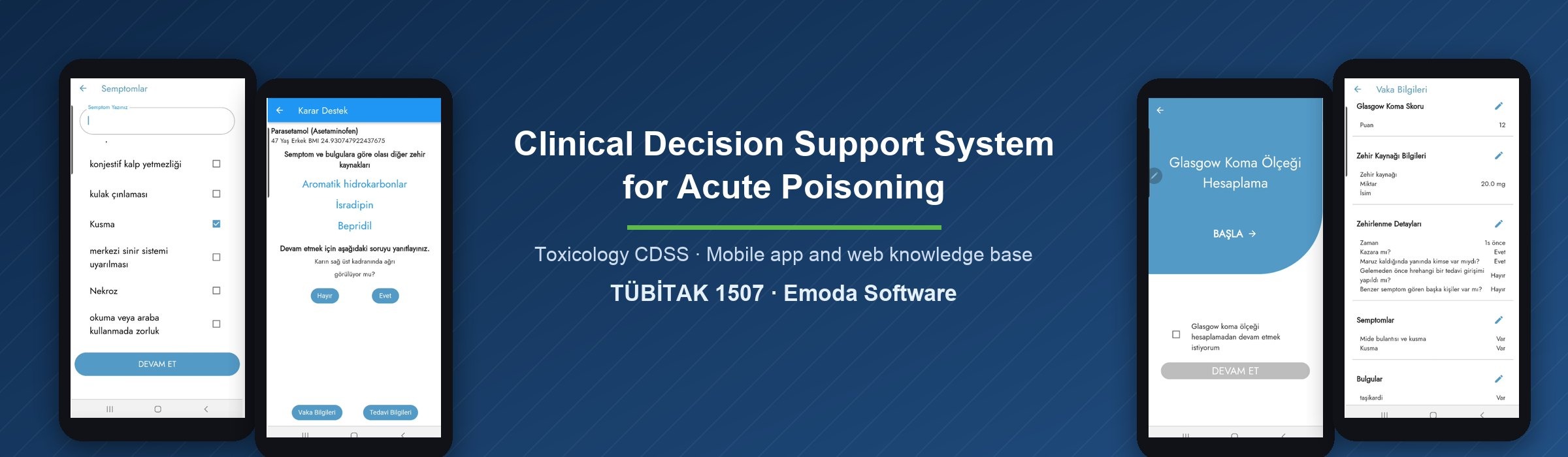
Development of a Decision Support System for Acute Poisoning was an R&D project carried out by Emoda Software from 1 April 2021 to 30 June 2022 under the TÜBİTAK 1507 SME R&D Start-up Support Programme, a national funding programme of TÜBİTAK, the Scientific and Technological Research Council of Türkiye. The project delivered a clinical decision support system (CDSS) that gives physicians the likely poisoning agent, diagnosis and treatment information for patients presenting with poisoning, a mobile app for physicians and a web-based panel for managing the knowledge base.
| Project name | Development of a Decision Support System for Acute Poisoning |
|---|---|
| Funding programme | TÜBİTAK 1507 SME R&D Start-up Support Programme (2021/1 call) – TÜBİTAK is the Scientific and Technological Research Council of Türkiye, the national public agency funding research and innovation |
| Project no | 7210179 |
| Duration | 1 April 2021 – 30 June 2022 (15 months) |
| Organisation | Emoda Software |
| Outputs | Rule-based clinical decision support service, Android mobile app, web-based knowledge base panel |
| Pilot | Tested in a real setting by emergency physicians |
Poisoning is one of the most common reasons for emergency department visits, and medicines are the leading reported poisoning agents in Türkiye (analgesics, antidepressants, etc.). Almost anything found at home or in nature can be a poisoning agent; each agent has its own symptoms and findings, toxic dose, antidote and treatment constraints that vary with age, sex and pregnancy. No physician can keep all of this knowledge in mind.
The CDSS was designed as an assistant at hand that gives structured, up-to-date information based on the patient's data.
The physician opens a new poisoning case in the mobile app and the system guides them step by step:
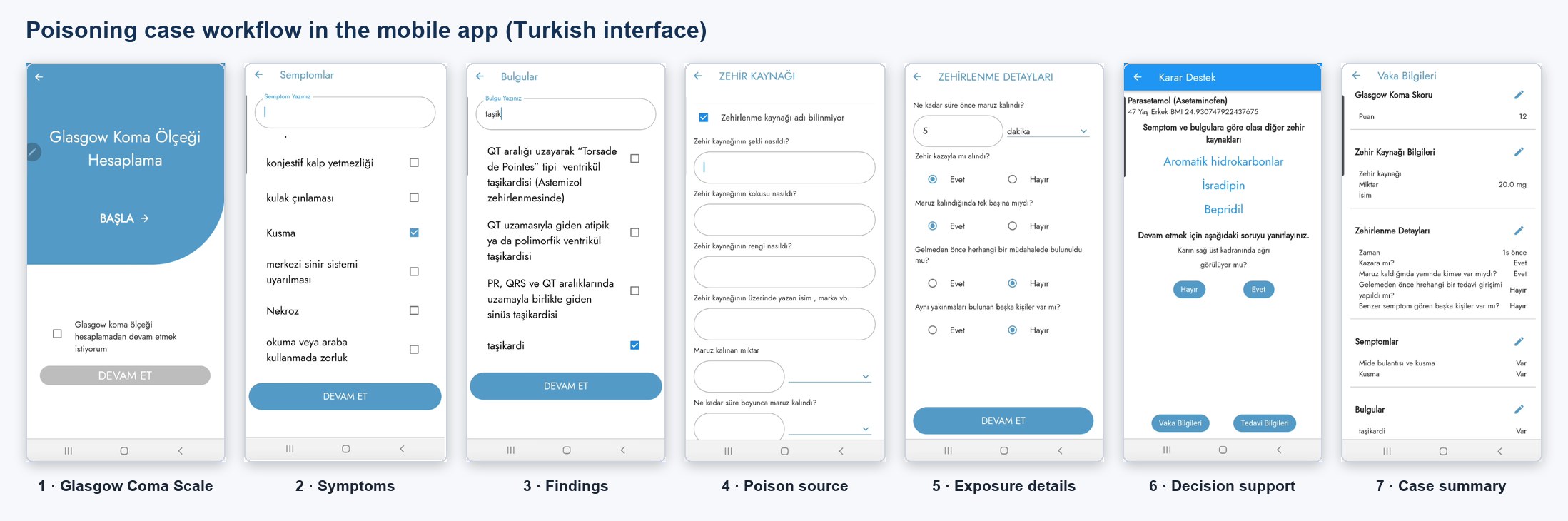
The decision support system works in two modes:
The rules were built from poisoning diagnosis and treatment guidelines, the poison information centre's guidance, current literature and the input of emergency medicine specialists working on the project. The system does not replace the physician's decision; it supports diagnosis and treatment.
Poisoning agents, symptoms, findings, treatments and sources are kept in a web-based management panel, where each agent is linked to its symptoms and findings and new agents, symptoms, findings and treatments are added. During development the panel contained more than 190 poisoning agents and more than 210 symptoms and findings.
Before the pilot, poisoning types such as paracetamol, phenytoin, carbamazepine, valproic acid, tricyclic antidepressants (imipramine, clomipramine, amitriptyline), barbiturates, antiarrhythmics, caffeine, nicotine, iron, arsenic, carbon monoxide and cyanide were tested with their symptoms and findings for different patient types, and the agents suggested by the system were checked. The product was then piloted with emergency physicians; their assessments were positive and their feedback made the app more practical.
The system was developed for emergency physicians, general practitioners working in emergency departments, hospitals and clinics that see poisoning cases, and physicians working in toxicology. Recording regional poisoning agents can also support planning such as antidote supply.
Funding: This project was supported by the TÜBİTAK 1507 SME R&D Start-up Support Programme under project number 7210179. TÜBİTAK (the Scientific and Technological Research Council of Türkiye) is Türkiye's national agency for funding research and innovation.
It is a rule-based clinical decision support system that gives physicians the likely poisoning agent, diagnosis and treatment information for patients presenting with poisoning, based on the Glasgow Coma Scale, symptoms, findings and poison source. Emoda developed it with TÜBİTAK 1507 support, together with a mobile app and a web-based knowledge base panel.
The project was supported by the TÜBİTAK 1507 SME R&D Start-up Support Programme (2021/1 call) under project number 7210179 and ran from 1 April 2021 to 30 June 2022. TÜBİTAK, the Scientific and Technological Research Council of Türkiye, is the country's national research and innovation funding agency.
In prediction mode the system suggests likely poisoning types to the physician based on the symptoms and findings, and requests additional information when needed to refine the assessment.
No. The system aims to save time by giving the physician structured information based on the case data; it does not replace the poison information centre (UZEM) or the physician's clinical decision.
In acute poisoning, consciousness has to be assessed in a standard way together with vital signs. The Glasgow Coma Scale scores eye opening, motor and verbal response and helps determine the patient's condition and treatment priority.
Before the pilot, poisoning types such as paracetamol, phenytoin, carbamazepine, valproic acid, tricyclic antidepressants (imipramine, clomipramine, amitriptyline), barbiturates, antiarrhythmics, caffeine, nicotine, iron, arsenic, carbon monoxide and cyanide were tested with their symptoms and findings; the system was then piloted with emergency physicians.
It was designed for emergency physicians, general practitioners working in emergency departments, and hospitals and clinics that see poisoning cases.
Selected for funding by the European Commission, the Horizon Europe project CLAR…
View
In the Eureka Eurostars-3 project NanoLoom, Emoda leads the development of the A…
View
Emoda is the only participant from Türkiye in the Horizon Europe LUCIA project,…
View