Horizon Europe · Neurology
CLARITY-PD: Causal Links of Air Pollution, Pesticides and Heavy Metals in Parkinson's Disease
Selected for funding by the European Commission, the Horizon Europe project CLAR…
View
Building healthcare technology since 2018 Schedule a demo with us
Last updated: · By Emoda Software
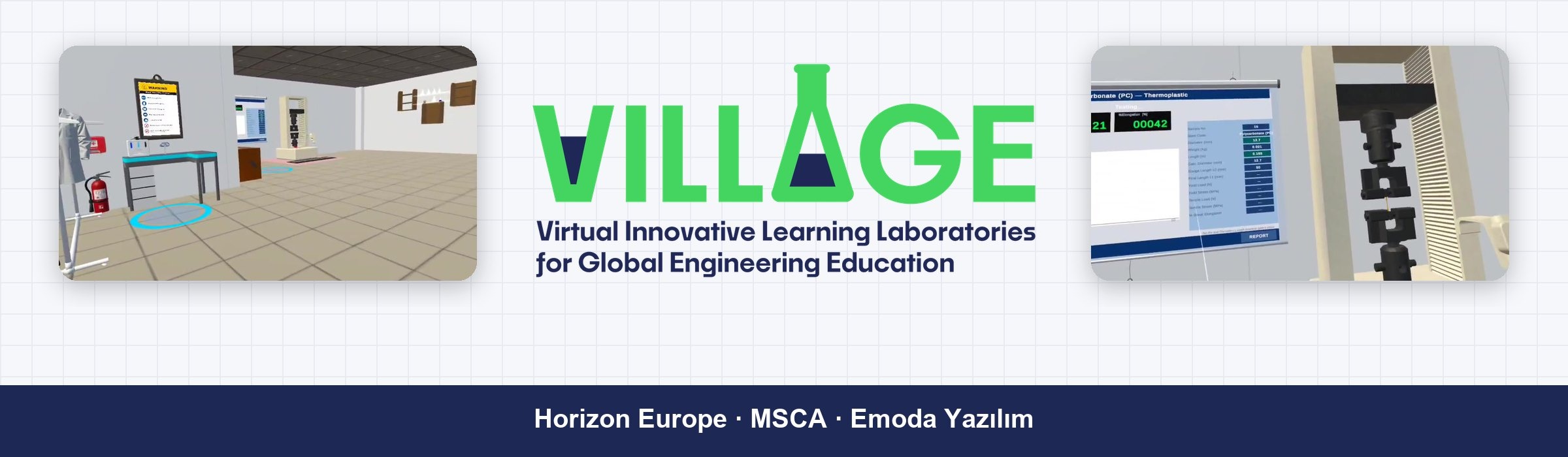
VILLAGE (Virtual Innovative Learning Laboratories for Global Engineering Education) is an international research and innovation project that re-examines the post-pandemic needs of laboratory teaching in engineering education and develops a virtual reality (VR) supported virtual laboratory model. It is funded under the Marie Skłodowska-Curie Actions (MSCA) Staff Exchanges of the European Union's Horizon Europe programme and coordinated by Ege University in İzmir. As the project's SME partner, Emoda Software develops the VR application of the pilot virtual laboratory VILLAGE-Lab.
| Project name | VILLAGE – Virtual Innovative Learning Laboratories for Global Engineering Education |
|---|---|
| Programme | Horizon Europe – Marie Skłodowska-Curie Actions (MSCA) Staff Exchanges, HORIZON-MSCA-2021-SE-01 |
| Grant agreement no. | 101086464 |
| Duration | 1 March 2023 – 28 February 2027 (48 months) |
| Coordinator | Ege University, İzmir |
| Consortium | 9 organisations from 8 countries: universities, a research institute and SMEs |
| Emoda's role | SME partner; development of the virtual reality (VR) application of the pilot virtual laboratory VILLAGE-Lab (Meta Quest, materials testing lab) |
| Official website | thevillageproject.eu |
The pandemic moved engineering lab classes online almost overnight, yet most virtual laboratories are not built on an instructional design model. VILLAGE starts from the real needs of instructors and students to build a sustainable model:
The team reviewed 201 publications on virtual laboratories in engineering education and held focus groups with 40 engineering instructors in Türkiye, Greece, Ireland, Latvia, Slovenia, Spain and Azerbaijan.
An open-access database of 60 instructional design models was created. Seventeen selected models were scored by 20 experts from the partner organisations; the top-ranked included the unified eLearning model, ASSURE, Agile instructional design, Kemp-Morrison-Ross and ADDIE. For VR-supported engineering education, the experts favoured flexible, cyclical models over rigid, sequential ones.
200 engineering instructors from five countries answered the survey. 65.5% had no VR experience in engineering education, yet interest in virtual reality was strong. The results show a need for training, resources and institutional support, and for addressing technical and pedagogical aspects together. Student needs are analysed in a separate study.
The VILLAGE instructional design model, built on these findings, is put into practice through VILLAGE-Lab, a VR-supported pilot virtual laboratory. It is developed by an interdisciplinary team: technology developers build the learning content and platform with a focus on usability, sustainability, scalability, modularity, accessibility and adaptability, while engineering and education experts assess academic suitability and effectiveness.
Emoda is the consortium's SME partner on the software and technology side:
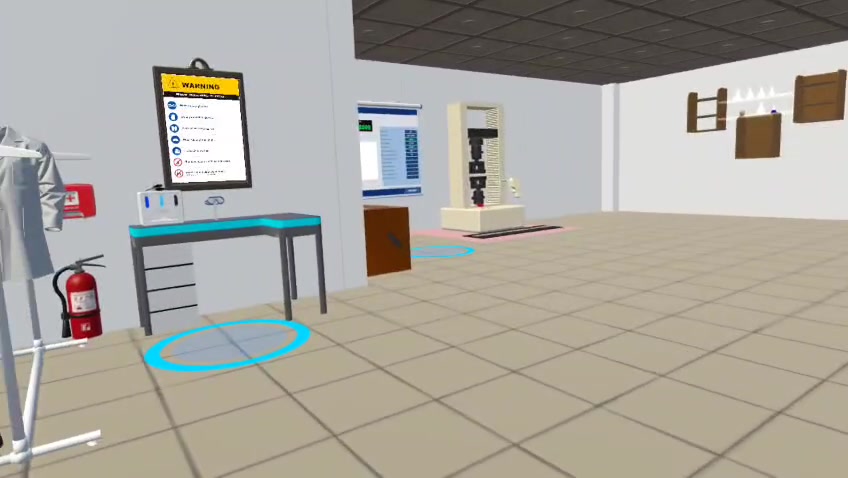
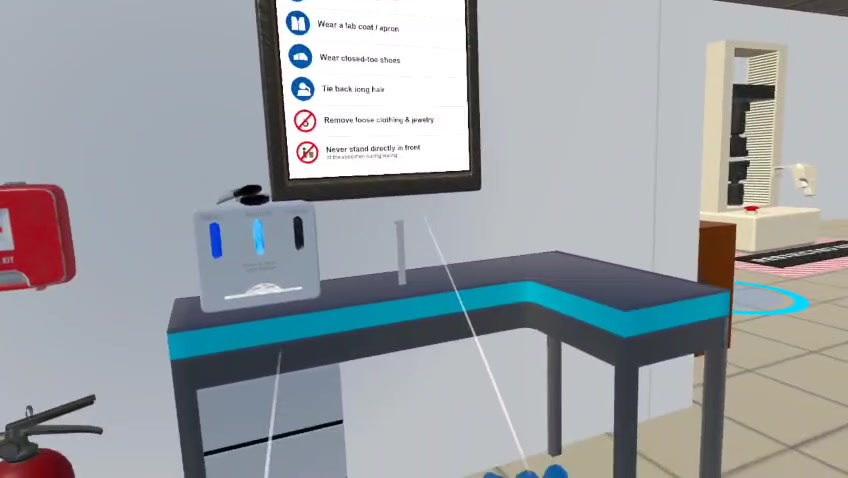
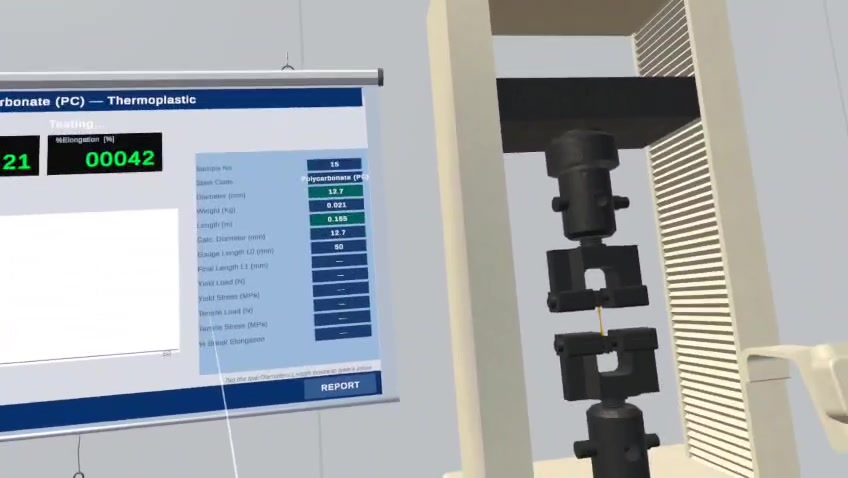
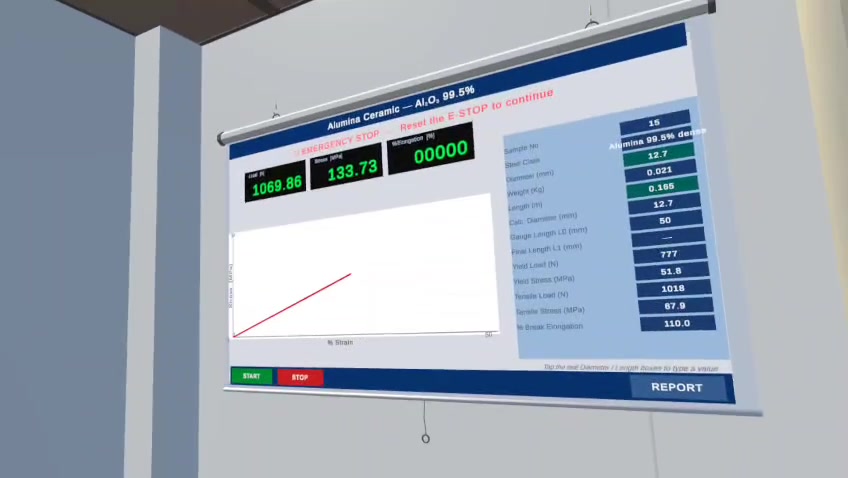
The VR application developed by Emoda runs on Meta Quest headsets. The lab in the application is a materials testing laboratory. Students first see the lab rules in a safety area equipped with a lab coat, safety goggles, a first aid kit and a fire extinguisher. They then select test specimens, measure them with a virtual caliper and mount the specimen in a tensile testing machine. Once the test starts, load, stress and elongation are shown on a live display and the stress–strain curve is drawn in real time.
Different materials can be tested, such as polycarbonate (thermoplastic) and alumina ceramic (Al₂O₃, 99.5%). Test conditions are defined according to standards such as ASTM C1273-18, and the lab includes an emergency stop and test report generation. Costly and risky lab experiments move into a safe virtual environment that students can repeat as often as they need.
MSCA Staff Exchanges is a Horizon Europe Marie Skłodowska-Curie Actions programme that supports the exchange of researchers and staff between universities, research organisations and companies around a joint research and innovation project. Staff spend periods working at partner organisations (secondments). In VILLAGE, Emoda team members were seconded to Azerbaijan State Agricultural University (Azerbaijan), Munster Technological University (Ireland), Kemijski Institut (Slovenia) and Riga Technical University – Liepāja Academy (Latvia), while academic partners worked at SMEs to support the needs analysis. This structure lets SMEs such as Emoda work directly with academic research.
VILLAGE's results are designed for engineering instructors who teach lab classes online or in hybrid form, engineering students learning with virtual labs and VR applications, instructional designers, and universities and companies developing education technology.
Organisations in the project:
The project's open-access reports (global state of the art, the instructional design model database and ranking, needs analysis reports and the model methodology) are available on the official project website.
Funded by the European Union
This project has received funding from the European Union's Horizon Europe research and innovation programme under the Marie Skłodowska-Curie grant agreement No 101086464. Views and opinions expressed are however those of the author(s) only and do not necessarily reflect those of the European Union or the European Research Executive Agency (REA). Neither the European Union nor the granting authority can be held responsible for them.
VILLAGE (Virtual Innovative Learning Laboratories for Global Engineering Education) is a project funded under Horizon Europe MSCA Staff Exchanges (1 March 2023 – 28 February 2027) that re-examines the post-pandemic needs of laboratory teaching in engineering education and develops a VR-supported virtual laboratory model.
The project is coordinated by Ege University in İzmir. The consortium includes universities, a research institute and SMEs, including Emoda Software, from Türkiye, Ireland, Slovenia, Latvia, Italy, Belgium, Spain and Azerbaijan.
As the project's SME partner, Emoda develops the virtual reality (VR) application of the pilot virtual laboratory VILLAGE-Lab; in the Meta Quest app, students run tensile tests in a virtual materials testing lab. It also contributed to scoring instructional design models and to focus groups on VR labs, and its team was seconded to partner organisations in Azerbaijan, Ireland, Slovenia and Latvia under the MSCA Staff Exchanges.
A Horizon Europe Marie Skłodowska-Curie Actions programme that supports the exchange of researchers and staff between universities, research organisations and companies around a joint research and innovation project.
The project built an open-access database of 60 instructional design models. Seventeen selected models were scored by 20 experts; the unified eLearning model, ASSURE, Agile instructional design, Kemp-Morrison-Ross and ADDIE were among the top-ranked.
First an internal pilot with at least 10 project researchers, then hybrid pilot sessions at the partner universities with at least 50 instructors and 250 students. The model and the lab will be finalised based on the feedback and released as open access.
Selected for funding by the European Commission, the Horizon Europe project CLAR…
View
In the Eureka Eurostars-3 project NanoLoom, Emoda leads the development of the A…
View
Emoda is the only participant from Türkiye in the Horizon Europe LUCIA project,…
View