Horizon Europe · Neurology
CLARITY-PD: Causal Links of Air Pollution, Pesticides and Heavy Metals in Parkinson's Disease
Selected for funding by the European Commission, the Horizon Europe project CLAR…
View
Building healthcare technology since 2018 Schedule a demo with us
Last updated: · By Emoda Software
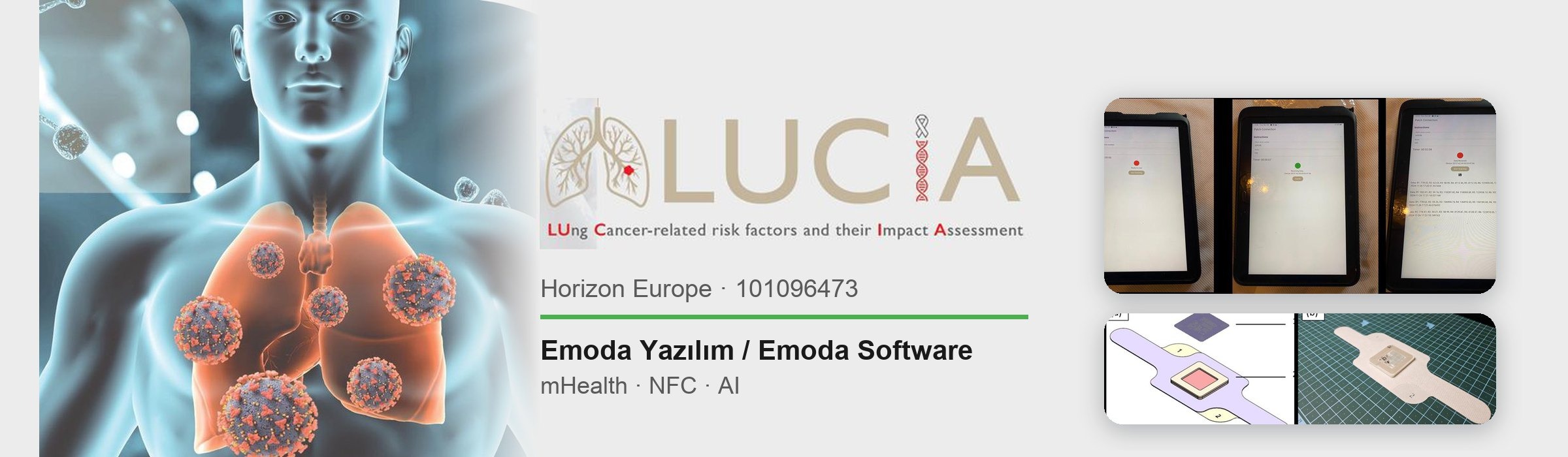
LUCIA (Understanding Lung Cancer related risk factors and their Impact) is a research project funded under the European Union's Horizon Europe Cancer Mission to discover new risk factors that lead to lung cancer and to understand their impact. Emoda Software is the only participant from Türkiye in a consortium of 22 organisations from 9 countries. Emoda develops the project's patient and clinician mobile health (mHealth) applications, and contributes to data ingestion, integration and harmonisation, geo-referenced patient cohort stratification and visualisation, and AI modelling of risk factors.
| Project name | LUCIA – Understanding Lung Cancer related risk factors and their Impact |
|---|---|
| Programme | Horizon Europe Cancer Mission (HORIZON-MISS-2021-CANCER-02-03) |
| Grant agreement no. | 101096473 |
| Duration | 1 January 2023 – 31 December 2026 (48 months) |
| Consortium | 22 organisations from 9 countries (6 EU Member States, 3 associated countries) |
| Clinical study | 4 clinical partners in Spain (Basque Country, Andalusia), Belgium and Latvia; 2,855 volunteers (April 2025) |
| Participant from Türkiye | Emoda Software |
| Emoda's role | Patient and clinician mHealth apps; data ingestion, integration and harmonisation; geo-referenced cohort analysis and visualisation; AI modelling of risk factors |
| Official website | LUCIA official project website |
A large share of lung cancer cases cannot be explained by smoking alone, and low-dose computed tomography (CT) screening is still under-used. LUCIA addresses this gap by building a toolbox for discovering and understanding new risk factors. The toolbox studies three interlinked areas together:
The toolbox combines cohort databases, AI models, wearables, non-invasive sensors and multi-omics analyses. The molecular changes it identifies are validated in the lab and in vivo.
LUCIA's findings are being tested in a prospective cohort study across four European regions. According to the project's June 2025 mid-period report, recruitment closed on 4 April 2025 with 2,855 volunteers enrolled against a target cohort of around 3,000. All participants have completed their baseline visit.
At baseline, volunteers are assessed with established lung cancer risk prediction models (LCRAT – Lung Cancer Risk Assessment Tool – and the Liverpool Lung Project (LLP) risk model) and low-dose CT results, and assigned to one of three phases:
The study places particular emphasis on lung cancer in never smokers and reduced smokers, with the aim of uncovering risk factors other than smoking. The new technologies being tested are a breath analyser (electronic nose) that profiles volatile organic compounds (VOCs) in exhaled breath, spectrometry-on-card, the wearable sensing patch (WBSP) and multi-omics analysis.
| Visit | Procedures |
|---|---|
| Baseline | Blood test, spirometry, lifestyle questionnaires, sociodemographic and medical record data, exposure to harmful agents, physical examination, low-dose CT, breath analyser and spectrometry-on-card testing |
| Month 6 | Remote visit: sociodemographic, medical record and exposure data |
| Month 12 | Spirometry, lifestyle questionnaires, sociodemographic, medical record and exposure data, physical examination |
| Month 24 | Spirometry, lifestyle questionnaires, sociodemographic, medical record and exposure data, physical examination, low-dose CT, breath analyser and spectrometry-on-card testing |
The results feed into policy recommendations for implementing lung cancer screening programmes.
Emoda's work in LUCIA covers four areas:
A central hub for collecting and storing lifestyle and environmental health determinants. A notification system delivers messages, alerts and reminders, and patients can organise their lifestyle data, records and notes in one place. Data from wearable devices is also captured through this app.
Lets clinicians follow each patient's biomarker readings from the technologies developed in the project, such as non-invasive sensors.
The clinician app is used to take measurements from the wearable sensing patch developed in the project (Wide-biomarker-spectrum Multi-Use Sensing Patch, WBSP). The clinician first selects the clinical centre and the participant; participants are shown by a unique LUCIA ID code, birth year and sex instead of their names. After entering the patch serial number and an optional note, the clinician brings the phone or tablet close to the patch and the measurement is read over NFC (NFC-V, ISO 15693). The measurement time is shown on screen; once saved, the results are uploaded automatically to the LUCIA Health Data Platform, where data from clinical centres in different countries can be analysed by authorised researchers. The patch is used in the precision screening and diagnosis phases of the clinical study.


Both apps use responsive design and are built through co-design with patients and clinicians.
In LUCIA, data comes from clinical centres in four countries, mobile apps, wearables and research devices, each with its own format and measurement method. Emoda contributes to ingesting this data, bringing it together on the LUCIA Health Data Platform and harmonising it into a common structure so that it can be analysed together. Measurements taken with the mobile apps flow to the platform automatically through the same pipeline.
The project's external risk factor strand (urban environment, traffic, climate and socio-economic conditions) is directly tied to where participants live. Emoda contributes to stratifying patient cohorts by geographic location and visualising these groups with maps and charts, so researchers can examine the link between environmental factors and lung cancer risk region by region.
LUCIA combines personal, environmental and biological data to look for new risk factors and develops its own LUCIA risk prediction model. Emoda contributes to modelling lung cancer risk factors with AI methods using data from the mobile apps and the data platform.
Consortium members:
All project publications and reports: LUCIA publications page.
Funded by the European Union
This project is funded by the European Union's Horizon Europe Research and Innovation Programme under Grant Agreement no 101096473. Views and opinions expressed are however those of the author(s) only and do not necessarily reflect those of the European Union or the granting authority. Neither the European Union nor the granting authority can be held responsible for them.
LUCIA is a 48-month research project (1 January 2023 – 31 December 2026) funded under the European Union's Horizon Europe Cancer Mission to discover new lung cancer risk factors and understand their impact.
Emoda Software, an Izmir-based healthcare software company, is the only participant from Türkiye in the consortium of 22 organisations from 9 countries.
Emoda develops the project's two mHealth apps: a patient app that collects lifestyle and environmental data, and a clinician app that reads sensing patch measurements over NFC. It also contributes to data ingestion, integration and harmonisation, geo-referenced patient cohort stratification and visualisation, and AI modelling of risk factors.
Personal factors (pollutant exposure, lifestyle), external factors (urban environment, traffic, climate, socio-economic conditions) and biological responses (ageing, genetic, epigenetic and metabolic changes).
The findings are validated in a three-phase clinical study (wide population screening, precision screening of high-risk groups, diagnosis) and turned into policy recommendations for lung cancer screening programmes.
According to the project's June 2025 mid-period report, 2,855 volunteers were enrolled at four clinical partners in Spain, Belgium and Latvia when recruitment closed on 4 April 2025. Participants are followed for 2 years with visits at baseline and months 6, 12 and 24.
Selected for funding by the European Commission, the Horizon Europe project CLAR…
View
In the Eureka Eurostars-3 project NanoLoom, Emoda leads the development of the A…
View
In VILLAGE, funded by the Horizon Europe MSCA Staff Exchanges programme, Emoda d…
View